


Why work with a scale company that builds automation
Most automation integrators don't service scales, and most scale companies don't write control logic. Brechbuhler does both, which matters because a weighing system is only as accurate as the scale underneath it.
- Scale-first engineering. We size and specify the scale, load cells and indicator before we write a line of PLC code.
- Vendor-neutral. We retrofit and replace aging Mettler Toledo and Rice Lake systems, and integrate with the controller you've already standardized on.
- Local service after install. 18 full-service branches support the system for its full life, not just commissioning.
- Since 1929. Brechbuhler has been weighing, servicing and calibrating industrial scales for nearly a century.
Systems we build
- Batching, filling and dosing. Automatic and manual ingredient batching, drum and tote filling, and loss-in-weight dosing for food, chemical, concrete and grain operations.
- Baggers and super sackers. Weigh-filling of bags and bulk bags for powders and granular products.
- In-motion checkweighing and conveyors. Weigh product while it moves and automatically reject out-of-spec items, with no stop on the line.
- Truck and rail loadout. Automated bulk loadout for cement, aggregate, grain and coal, tied to the truck or rail scale.
- RFID, barcode and telemetry. Identify trucks, containers and products automatically, often paired with ScaleSoft truck scale software.
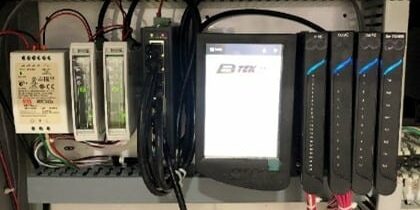
- PLC/PAC controls and HMI. Custom weighing logic, HMI screens and data connections to SCADA and ERP.
- Custom weighing systems. Purpose-built equipment such as the split-rail carcass weighing system described below.
Which system fits your process?
| Your problem | System | Typical components | What changes |
|---|---|---|---|
| Batches are inconsistent or built by hand | Automated batching | Scale hoppers, feeders, valves, PLC, recipe database | Repeatable batches with recorded weights |
| Old batching controller has no parts or support | Batching system replacement | New PLC, network I/O, HMI, recipe database | Supported platform, remote access, less downtime |
| Underweight or overweight packages reach customers | In-motion checkweigher | Conveyor scale, load cells, reject arm, PLC | Out-of-spec items rejected automatically |
| Trucks wait while staff weigh and ticket | Automated truck scale / loadout | Truck scale, RFID or kiosk, loadout controls, ScaleSoft | Faster turns, fewer ticket errors |
| Weights are typed into spreadsheets | Connected weighing | Indicators, PLC/PAC, SCADA or ERP link | Weight data flows to reporting automatically |
| Material is filled into bags by hand | Bagger / bulk bag filler | Filling scale, spout, controls | Consistent fill weights at higher speed |
Controls and integration
We program controller logic for your specific process, including batching sequences, checkweigh thresholds and multi-scale coordination, rather than adapting a generic template. Systems connect to the HMIs, SCADA and ERP platforms your plant already runs.
- Controllers: All major PLC and PAC platforms. We program a new controller or work within the one your plant has already standardized on.
- Networks: EtherNet/IP and the other industrial networks those platforms use, plus networked I/O for valves, push buttons and field devices.
- Data: Recipe and historical data stored in a central database, with remote access for off-site monitoring.
- Legal for trade: Where weights are used for buying or selling, systems are built with NTEP-rated components and installed to NIST weights and measures standards.
How a project works
- Site visit and evaluation. We study the process on site to find the bottleneck and the right point to capture weight.
- Engineering and design. Our engineers design the mechanical, electrical and control systems together.
- Build and shop testing. Assemblies and panels are built and tested before they reach your floor.
- Installation and commissioning. Installed to fit your existing layout, often as a drop-in assembly, to limit downtime.
- Tuning and lifetime service. We fine-tune with your operators after start-up, and your local branch services the system from then on.
Timelines depend on scope; your branch includes a schedule with the proposal.
Recent projects
| Project | Industry | What we built | Result |
|---|---|---|---|
| Mettler Toledo batching system replacement | Process / batching | New PLC with network I/O, automatic and manual ingredient filling, remote access, recipe database | Unsupported legacy controller replaced with a serviceable platform |
| In-motion checkweighers, Fort Wayne | Manufacturing | Two conveyor checkweighers with PLC integration and automatic reject | Real-time weights and automatic rejection of out-of-spec product |
| Bulk cement loadout | Construction materials | Opto 22 PAC logic mapped over EtherNet/IP into the existing PLC | Fully automated filling with less manual oversight |
| Split-rail carcass weighing | Meat processing | Dual split rails on stainless shear beam load cells, galvanized housings, drop-in to the existing overhead track | Weight captured in-line with no extra handling |
| Packaging line box weighing | Manufacturing | Load cells built into the conveyor, automatic reject arms | Box weights captured on a moving line |
More projects: Automated Weighing Solutions Library.
Industries we serve
Petrochemical, agriculture and grain, food and beverage, meat processing, manufacturing and packaging, transportation and logistics, and construction materials such as cement and aggregate. See industries served for examples.
Served by your local branch
Every system is quoted, installed and supported through your nearest Brechbuhler branch. Contact the branch closest to your facility and your request is routed to the engineering team.
Ohio · Indiana · Pennsylvania · West Virginia · Michigan · Kentucky · Illinois
Frequently asked questions
What is an automated weighing system?
An automated weighing system combines scales or load cells with controls, usually a PLC or PAC, to weigh, batch, fill, check or load product without manual steps. It records each weight automatically and can act on it, such as stopping a fill, rejecting a package or printing a ticket.
What's the difference between semi-automatic and fully automatic weighing?
A semi-automatic system automates the weighing and recording but still relies on an operator for some steps, such as hand-adding a minor ingredient. A fully automatic system runs the whole sequence from the controller. Many plants start semi-automatic and add automation in phases.
Can you replace an old Mettler Toledo or Rice Lake batching system?
Yes. We regularly replace unsupported Mettler Toledo and Rice Lake batching controllers with a modern PLC-based system. We often keep your existing scales, hoppers and valves where they're still sound, so the upgrade costs less than a full rebuild.
Can a new weighing system connect to our existing PLC?
In most cases, yes. We review your current controller and network, then map weight data and control signals into it, for example over EtherNet/IP, so you don't replace equipment that already works.
Can weight data go to our ERP or SCADA system?
Yes. We connect weighing systems to HMI, SCADA and ERP platforms so weights reach reporting and inventory without anyone typing them in.
Are automated weighing systems legal for trade?
They can be. When weights are used to buy or sell product, we build with NTEP-rated components and install to NIST weights and measures requirements. The system then needs to be inspected and sealed by your state's weights and measures office.
How much does an automated weighing system cost?
Cost depends on the scale capacity, the number of ingredients or lanes, the controls and the integration involved. A simple checkweigher retrofit costs far less than a multi-ingredient batching plant. Your local branch provides a fixed proposal after a site evaluation.
Who services the system after installation?
Your nearest Brechbuhler branch does. With 18 full-service branches, the same company that built the system handles calibration, repair and preventive maintenance.
What areas do you serve?
We design and install automated weighing systems across Ohio, Indiana, Pennsylvania, West Virginia, Michigan, Kentucky and Illinois, and travel beyond that region for larger projects.
Watch: inside our engineered solutions
In this episode of The Weigh It Is, the Brechbuhler Engineered Solutions team walks through how they approach automation: real problems from the field, why custom systems outperform off-the-shelf equipment on difficult applications, and how turnkey systems improve accuracy and efficiency.
Inside Brechbuhler’s Engineered Solutions | The Weigh It Is
A 43-minute look inside Brechbuhler’s engineered weighing solutions, from The Weigh It Is series.
Talk to an engineer about your process
Tell us what you're weighing, how fast and where the data needs to go. Contact your nearest branch and we'll route your request to our engineering team for a site evaluation.
OUR MOTTO: TAKE CARE OF THE CUSTOMER