


What Should You Look for on an ISO 17025 Accredited Scale Calibration Certificate? | Mansfield OH Scale Calibration Guide
A Guide for Truck Scales and Industrial Scales in Mansfield, Ohio
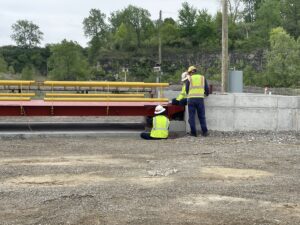
If your business relies on accurate weight measurements, understanding your calibration documentation is critical.
An ISO 17025 calibration certificate explained clearly provides proof that your scale was tested using internationally recognized standards, accredited procedures, and traceable measurement references.
For businesses operating truck scales, industrial scales, or laboratory balances in Mansfield, Ohio and surrounding areas like Ashland, Bucyrus, Ontario, Shelby, and Galion, reviewing your calibration documentation helps ensure:
- Regulatory compliance
- Accurate weight measurements
- Reliable quality control
- Audit-ready documentation
But what exactly should appear on a proper ISO 17025 accredited scale calibration certificate?
Experienced Local Technicians You Can Trust
At Brechbuhler Scales in Mansfield, our service team brings over 75 years of combined experience to every calibration.
Our local technicians — Ron, Steve, and Adam — have built a reputation throughout the region for precision, reliability, and deep industry knowledge. Their hands-on expertise working with truck scales, industrial systems, and lab equipment allows them to identify issues quickly and ensure your equipment performs at the highest level.
Unlike many competitors, our team doesn’t just complete a calibration — they understand the full operational impact of your scale and ensure it meets both compliance standards and real-world performance expectations.
(If available, this is a great place to include a team photo to highlight the local experts behind the service.)
Quick Answer: What Should an ISO 17025 Calibration Certificate Include?
An ISO 17025 accredited scale calibration certificate should include:
- An accredited calibration mark
- The A2LA or ANAB logo
- Calibration results traceable to SI units
- Measurement uncertainty stated
- As-found and as-left data
- Equipment identification (model, serial number, location)
- Environmental conditions during calibration
- Calibration procedures and standards used
- Technician and laboratory identification
These elements verify that the calibration meets internationally recognized standards for measurement accuracy and traceability.
- An Accredited Calibration Mark
One of the first things to verify on a calibration certificate is the accredited calibration mark.
Accredited laboratories are evaluated by independent organizations to ensure they meet ISO/IEC 17025 standards for technical competence and measurement accuracy.
In the United States, common accreditation bodies include:
- A2LA (American Association for Laboratory Accreditation)
- ANAB (ANSI National Accreditation Board)
Your certificate should display the A2LA or ANAB logo along with the laboratory’s accreditation number.
Why this matters
An accredited calibration mark confirms:
- The laboratory follows verified calibration procedures
- Equipment and measurement standards are properly maintained
- The documentation will hold up during audits and inspections
- Traceability to SI Units
Another critical requirement is confirmation that measurements are traceable to SI units.
Traceability means calibration measurements can be linked through a documented chain back to national or international standards (typically NIST in the U.S.).
Why SI traceability is important
- Ensures consistent measurements across laboratories
- Supports accurate billing and transactions
- Meets quality system requirements
- Measurement Uncertainty Stated
Measurement uncertainty represents the range within which the true measurement value is expected to fall.
Why it matters
- Defines precision of your equipment
- Helps verify tolerance compliance
- Supports quality control decisions
- As-Found and As-Left Data
A proper report should include:
As-Found Data – performance before adjustment
As-Left Data – performance after calibration
Why this matters
- Tracks scale drift over time
- Documents corrections
- Supports audits and compliance
- Equipment Identification
Each certificate should clearly identify:
- Scale type
- Manufacturer
- Model and serial number
- Location
- Calibration date
- Environmental Conditions During Calibration
Conditions such as temperature and humidity are often recorded to ensure calibration accuracy.
- Calibration Methods and Standards Used
Your certificate should document:
- Procedures followed
- Reference weights used
- Test points across capacity
- Technician and Laboratory Identification
The certificate should include:
- Accredited laboratory name
- Contact information
- Technician or authorized signatory
- Issue date
This ensures accountability and traceability.
Why ISO 17025 Calibration Certificates Matter for Mansfield Businesses
Businesses operating truck scales in Mansfield, OH depend on accurate measurements for:
- Freight billing
- Agriculture
- Scrap and recycling
- Waste management
- Manufacturing logistics
Working with an experienced local team like Brechbuhler Scales ensures not only compliance, but confidence in every measurement.
Frequently Asked Questions
What is an ISO 17025 calibration certificate?
Documentation verifying calibration meets international standards for accuracy and traceability.
What does measurement uncertainty mean?
The expected range of the true measurement value.
Why are as-found and as-left data important?
They document performance before and after calibration adjustments.
What logos should appear?
A2LA or ANAB accreditation marks.
ISO 17025 Scale Calibration Services in Mansfield, Ohio
At Brechbuhler Scales, we provide accredited scale calibration services throughout Mansfield and surrounding areas.
With over 75 years of combined experience, our technicians deliver precise calibrations and detailed, audit-ready reports that meet ISO 17025 requirements.
We support calibration for:
- Truck scales
- Industrial floor scales
- Bench scales
- Laboratory balances
If you need reliable calibration or want to review your current documentation, our Mansfield team is ready to help.