

When a Truck Scale Upgrade Becomes the Right Move: A Four-Scale Project in Youngstown
Every so often we walk into a facility where the truck scales themselves aren’t failing — they’ve just been outgrown.
That was the case at a customer site in the Youngstown area. Over time their fleet had changed. Trucks were larger, loads were heavier, and the pace of the operation had increased. The existing scales were still functioning, but the platforms were no longer large enough for the equipment moving across them every day.
Drivers were having to reposition vehicles to get accurate weights, and trucks occasionally stretched close to the edges of the deck. It slowed traffic through the yard and made weighing less efficient than it should be.
Situations like that usually mean it’s time to step back and look at the system as a whole.
Starting With a Walkthrough
An employee from our Youngstown branch met the customer on-site to walk through the facility and understand how trucks were moving through the yard. That conversation helped confirm what everyone was already seeing — the current setup wasn’t keeping up with the operation anymore.
This wasn’t something that could be solved with routine truck scale calibration or a small repair. The issue was scale size and capacity relative to the fleet.
The discussion quickly shifted toward designing a system that would support both current traffic and future growth.
Building the Right Truck Scale System
After reviewing the site layout and production needs, the project moved forward with a four-scale upgrade.
The installation included:
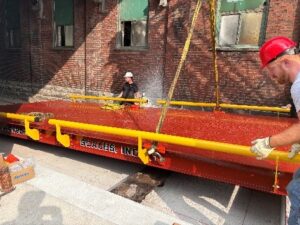
• Four B-TEK Centurion truck scales
• Four B-TEK SkyNet1010 weight indicators
• Custom programming configured around the customer’s production workflow
The Centurion truck scales are designed for heavy industrial traffic, with steel decks and load cells capable of handling high-capacity loads day after day. For a facility moving large trucks continuously, durability matters just as much as accuracy.
The SkyNet1010 indicators handle the operational side — capturing weight data in real time and supporting programmable functions that allow the system to fit the customer’s reporting and production processes.
Rather than installing a generic configuration, our systems team worked with the customer to tailor the programming so the scale system aligned with how trucks actually move through their facility.
Installation Challenges: Working Under Roof
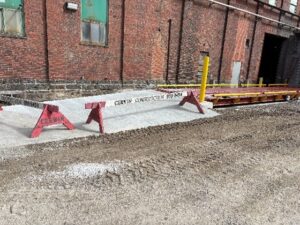
Installing four truck scales on a tight timeline always requires careful coordination. In this case, the work was split into two installation campaigns to minimize disruption to the operation.
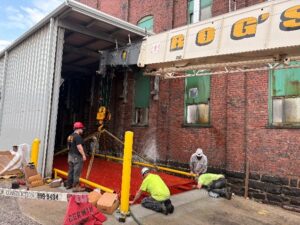
Two of the scales were located outdoors, but the other two were positioned under roof.
That changes the installation process quite a bit. Without the ability to use a crane to place large scale sections, the team had to roll and position the decks manually in a confined space with limited overhead clearance.
Getting everything aligned correctly takes patience. Load cells must sit squarely, the decks have to be leveled, and weight needs to transfer evenly through the structure. Small installation errors can turn into long-term alignment problems if they aren’t handled properly from the start.
The Youngstown branch installers worked through the space limitations and completed the installation with everything positioned and prepared for calibration.
Truck Scale Calibration: The Final Step
Once the equipment is installed, the system still needs to be verified for accuracy.
Truck scale calibration ensures each platform delivers reliable, repeatable weight readings. Accurate measurements are critical for everything from production tracking to regulatory compliance, so this step receives careful attention from our technicians.
With calibration complete, the system becomes a dependable part of the customer’s daily operation.
A System That Matches the Operation
With the new scales in place, trucks now fit comfortably on the platforms and drivers can move through the weighing process without constant repositioning. Traffic flows more smoothly through the yard, and the facility has a system built to handle the equipment they’re running today.
Truck scales are designed to last for decades, but operations change. Vehicles get larger, loads increase, and the equipment that once worked perfectly may no longer match the demands of the business.
When that happens, upgrading the scale system often makes more sense than continuing to work around the limitations.
Projects like this are a reminder that the right weighing system isn’t just about capturing a number — it’s about supporting the entire operation behind it.