


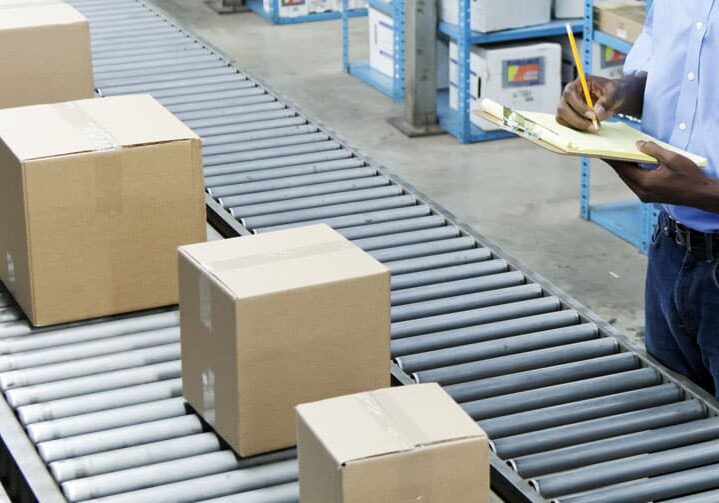
Check weigh systems are designed to weigh pre-packaged goods or products to verify desired weight within a range of tolerance to ensure accuracy and consistency. This tolerance is typically classified in terms of over tolerance, under tolerance, and acceptable tolerance. Packages that are classified as accepted are typically conveyed to a shipping location and further prepared for transport. Those classified as over/under are typically rejected and conveyed to a location for further inspection and repackaging. These systems can be designed to operate statically, in-motion, and high-speed in-motion. They can be designed with barcode/RFID scanners, printers, metals detectors, and various other enhancements.
Industries include:
- Fasteners
- Food and Beverage
- Kit Validation (such as a kit of parts, assembly instructions, and other collateral)
- Chemical Industries (medical, pharmaceutical)
- And more…
It has been our experience over the years that most clients in all industries experience some degree of problems (or pain) with some system or process within their facility. That pain can be:
Financial in that they are spending too much time and money on a legacy system that needs updated or replaced.
Productivity in that the system they are using may no longer be performing as efficiently as it once did due to changes or enhancements in operations.
Support-related in that they are not receiving cost-efficient, timely, or satisfactory support.
Why in-motion check weighing with Brechbuhler
An in-motion check weighing system only earns its place on your line if it stays accurate at speed, integrates cleanly with the rest of your production floor, and doesn't create a new bottleneck where it's meant to remove one. Brechbuhler engineers check weighing and conveyor systems around your actual throughput, tolerance, and reject-handling requirements rather than a one-size-fits-all package.
Accuracy that holds up at speed
Static accuracy is easy. Holding that same accuracy on packages moving down a conveyor at production speed is where most check weighing systems fall short. We calibrate and tune systems to your real running conditions, not just a bench test.
Reject and divert handling built in
Over, under, and accept tolerances need somewhere to go. We design reject and divert logic into the conveyor system itself, so out-of-tolerance packages are automatically routed for inspection or repackaging without slowing the accepted stream.
Built to integrate, not sit alone
Our check weighing systems are commonly paired with barcode or RFID scanners, printers, and metal detectors, and we make sure the data from each of these devices flows into your existing reporting and control systems rather than living in a silo.
Core check weighing and conveyor solutions
Static, in-motion, and high-speed in-motion systems
Depending on your product, packaging, and line speed, we design systems ranging from static check weighing stations to high-speed in-motion lines capable of weighing hundreds of packages per minute without disrupting flow.
Conveyor design and integration
Beyond the scale itself, we design the conveyor sections, transitions, and controls that move product through the weighing zone smoothly, minimizing the vibration and momentum changes that hurt in-motion accuracy.
Enhanced verification options
Many of our check weighing systems are configured with barcode/RFID identification, automated printing, and metal detection, so weight verification is just one part of a broader quality and traceability process.
In-motion check weighing FAQs
How accurate is an in-motion check weighing system compared to a static scale?
A well-designed in-motion system can approach static scale accuracy, but it depends heavily on conveyor speed, package stability, and proper calibration. We tune each system to your specific line conditions to get as close to static accuracy as your speed requirements allow.
What happens to packages that fail the weight check?
Out-of-tolerance packages are automatically diverted by the conveyor system to a separate location for inspection, repackaging, or disposal, so they never reach shipping alongside accepted product.
Can check weighing systems integrate with barcode or RFID scanners?
Yes, we regularly design check weighing lines with integrated barcode or RFID identification, along with printers and metal detectors, so weight data, product identity, and quality checks are all captured together.
How often does an in-motion check weighing system need to be recalibrated?
Most systems benefit from calibration checks at least once or twice a year, though high-volume or high-speed lines may need more frequent verification to maintain tight tolerances.
Can an existing conveyor line be retrofitted with check weighing?
In many cases, yes. We evaluate your existing conveyor layout and line speed to determine whether a check weighing section can be integrated into your current setup or whether a redesign makes more sense.
Do you service check weighing and conveyor systems outside of Ohio?
Yes, our technicians travel to service check weighing and conveyor systems across a wide service area beyond Ohio. Contact us with your location and we'll let you know how we can help.
OUR MOTTO: TAKE CARE OF THE CUSTOMER